


Bluff Prehistory—The Origins
People have been attracted to this area along the San Juan River for thousands of years.
As early as 13,000 years ago, the hunter/gatherer Clovis people, considered to be ancestors of most American indigenous cultures, hunted at a site less than 15 miles from Bluff. A petroglyph thought to be of a mammoth/bison has been found at Sand Island 4 miles from Bluff.
The transition to farming occurred with the Ancestral Puebloans, the first to establish permanent settlements in Bluff, who built small pit houses at first, then larger, multi-room dwellings. Archaeologists date the first Bluff establishments to around 650 A.D. By 1300 A.D., the Ancestral Puebloans had vanished from the area.
In the immediate Bluff area, archaeologists have excavated a Basketmaker site, a large Pueblo I site, and the Pueblo III Bluff Great House.
Native Americans
Following the prehistoric cultures, nomadic tribes of Paiutes, Utes, and Navajos were well established in the San Juan country area by the late 1500′s.
San Juan Band Paiutes hunted, foraged for seeds and roots, and farmed along the river bottom. Utes took full advantage of the introduction of the horse and lived a life similar to the Plains Indian cultures.
In the mid-19th century, Utes were hired by explorers and pioneer groups to guide expeditions and fight neighboring Navajos, who had migrated from northern Canada and spread into southern Utah. Navajos farmed the San Juan River flood plains and pastured sheep in the nearby mountains. After a number of conflicts, government military campaigns, and the tragic Long Walk to New Mexico, the Southwestern domain was once again opened to Native American and Anglo use precipitating rapid and dramatic changes to the Navajo and Ute ways of life. While Paiutes no longer have a presence in the region, these three Native American tribes played significant roles in the development of the area.
Anglo Settlement
Few settlers of European descent called the Bluff valley home until 1880 when the Hole in the Rock expedition of Mormon (Latter-day Saints) pioneers settled Bluff. The pioneers were “called” by the church for a mission to colonize southeastern Utah and minimize “untoward men” from settling this corner of Utah. The original Bluff Fort was laid out with a log cabins, church, school, and co-op store in the center, and was surrounded by agricultural fields and orchards. Farming along the San Juan River proved uncertain, for the river either flooded or went dry too often for dependable irrigation.
Large-scale livestock production in the 1880’s and 90’s brought prosperity to Bluff. The original log cabins were replaced by hand-hewn, red rock houses in the Victorian Eclectic style, some quite large and elegant, others built of wood frame lumber. Four of these homes are now listed on the National Historic Register. See the virtual Bluff History Tour.
Because they could not tame the San Juan River, many of the original pioneer families left Bluff for Grayson, Utah, now known as Blanding, twenty-five miles to the north.
Bluff’s 20th century economic history is replete with the rise and fall of mining ventures in coal, gold, oil and uranium, together with the challenges of cattle ranching and farming along the erratic San Juan River.
Father Baxter Liebler, an Episcopal priest from Connecticut, arrived in the 1940’s and established St. Christopher’s Mission east of town bringing Christian teachings to the Navajo, and helping to improve their health and sanitary conditions.
Visionary geologist Gene Foushee, and wife Mary, were instrumental in bringing visitors to Bluff with the building of Bluff’s first motel, Recapture Lodge, in the 1960’s, along with the restoration of the lovely pioneer homes.
LIVE THE STORY
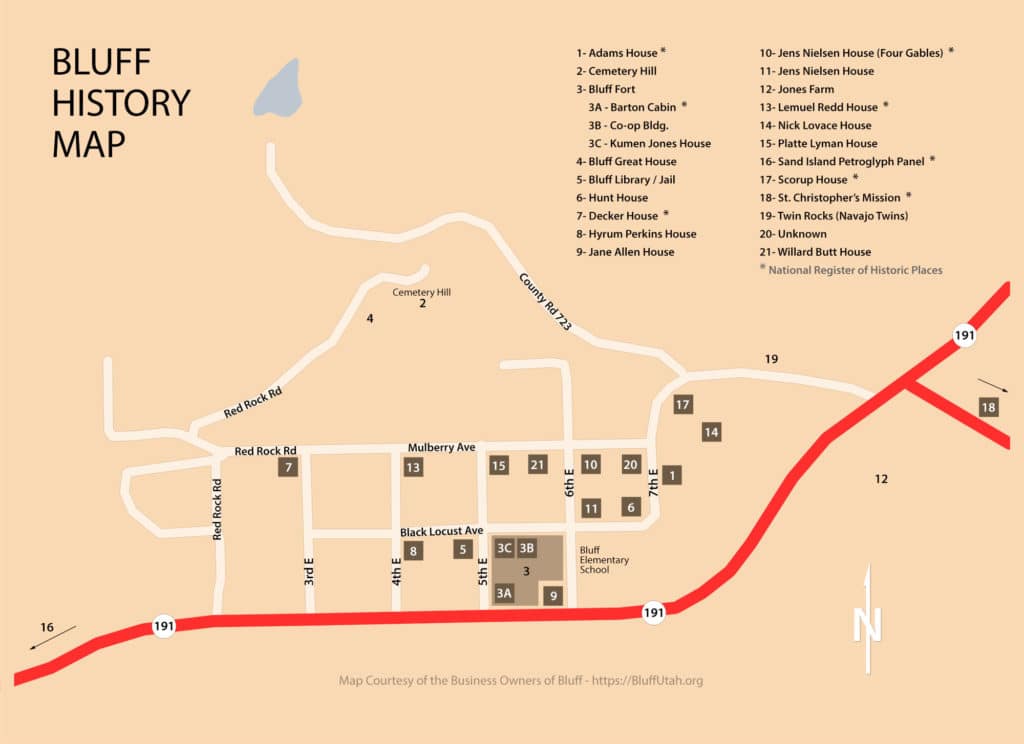
Bluff History Tour
The original 1880 Bluff City townsite, now the Bluff Historic District, is listed on the National Register of Historic Places. It is bounded by 2nd Street East, Main Street, Cemetery Hill, and the bluffs, including the Twin Rocks. Cemetery Hill has an awe-inspiring view of the San Juan River valley, and is the site of Bluff Great House, an important archeological site from the Pueblo II – III era. St. Christopher’s Mission, Sand Island Petroglyph Panel, and the Hole-in-the-Rock trail are also on the National Register of Historic Places.
1- Adams House*
2- Cemetery Hill
3- Bluff Fort
3A – Barton Cabin*
3B – Co-op Bldg.
3C – Kumen Jones House
4- Bluff Great House
5- Bluff Library / Jail
6- Hunt House
7- Decker House*
8- Hyrum Perkins House
9- Jane Allen House
10- Jens Nielsen House (Four Gables)*
11- Jens Nielsen House
12- Jones Farm
13- Lemuel Redd House*
14- Nick Lovace House
15- Platte Lyman House
16- Sand Island Petroglyph Panel*
17- Scorup House*
18- St. Christopher’s Mission*
19- Twin Rocks (Navajo Twins)
20- Unknown
21- Willard Butt House
* National Register of Historic Places